The SaaS industry is still growing rapidly in 2026 despite major shifts caused by AI, automation, and changing customer expectations. Recent industry reports estimate the global SaaS market at over $312 billion to $374 billion with annual growth rates between 14% and 18%. AI-powered SaaS tools, vertical SaaS products, and automation platforms are dominating startup conversations right now.
At the same time, the market has become brutally competitive. Generic tools are getting commoditized quickly, and founders who build “just another dashboard” often struggle to survive. The good news? Small founders now have better tools, lower startup costs, and faster development workflows than ever before. According to founder discussions and MVP cost surveys, many SaaS startups now launch for under $50/month using modern tools like Next.js, Supabase, and AI coding assistants.
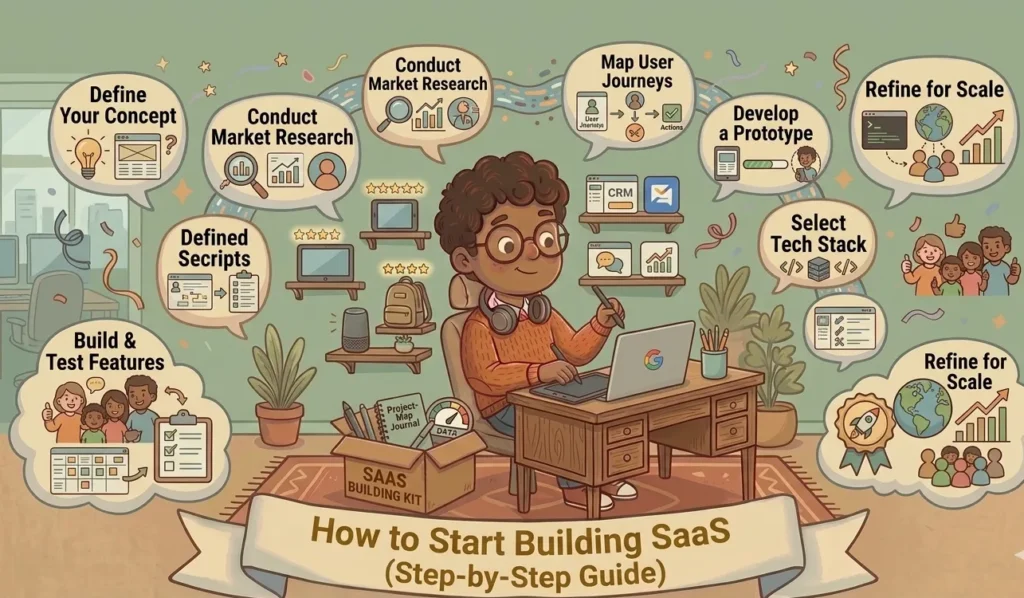
If you’ve been wondering how to start building SaaS without a huge team or venture capital, this guide walks you through the exact roadmap.
Table of Contents
Understanding What SaaS Actually Means
Before building a SaaS product, you need to understand what makes SaaS different from regular software. SaaS stands for Software as a Service. Instead of users downloading software once and owning it forever, SaaS products live online and operate through subscriptions. Think about tools like Notion, Slack, or Figma. Users pay monthly or yearly to access them through the browser.
This business model became massive because it solves several headaches at once. Companies don’t need complicated installations anymore. Updates happen automatically. Teams can collaborate in real time. And founders get recurring revenue instead of chasing one-time sales. That recurring revenue is the reason SaaS became so attractive to entrepreneurs and investors over the last decade.
The game is changing in 2026, though. AI has completely shifted expectations. Users now expect automation, personalization, and intelligent workflows inside SaaS products. Industry reports show that over 72% of SaaS companies have integrated AI features into their products already. That means building a SaaS company today isn’t just about creating dashboards anymore. Customers want tools that save time, automate repetitive work, and produce results quickly.
Another major shift is the rise of “micro SaaS” businesses. Small teams — sometimes even solo founders — are launching profitable SaaS products without millions in funding. Modern infrastructure is cheaper than ever. AI coding tools accelerate development dramatically. The barriers to entry dropped, but competition exploded at the same time. It’s a bit like opening a coffee shop in a city full of cafés. The opportunity is real, but you need a unique angle and a real customer pain point.
Choosing the Right SaaS Idea
Most SaaS products fail because founders build things nobody actually needs. That sounds harsh, but it’s true. Many beginners get excited about flashy AI tools or trendy startup ideas without validating demand first. The best SaaS ideas usually come from painful problems people already complain about daily.
Instead of asking, “What app should I build?” ask this: “What repetitive frustration costs people time or money?” That question changes everything. Successful SaaS products often remove friction from boring but expensive workflows. Businesses happily pay for software that saves hours, improves revenue, or eliminates manual tasks.
You’ll notice a huge trend toward vertical SaaS in 2026. Vertical SaaS focuses on specific industries instead of broad audiences. For example:
- SaaS for dentists
- SaaS for gyms
- SaaS for logistics companies
- SaaS for real estate agencies
These niche-focused tools often perform better because they solve deeper problems. Broad “all-in-one” platforms face brutal competition from giants. Narrow solutions can dominate smaller markets more easily.
Here’s a quick comparison:
| SaaS Type | Description | Example |
|---|---|---|
| Horizontal SaaS | Broad audience tools | Slack |
| Vertical SaaS | Industry-specific tools | Software for dentists |
| Micro SaaS | Small focused tools | AI invoice generator |
One mistake beginners make is trying to build giant platforms immediately. That’s like trying to build a skyscraper before learning how to pour concrete. Start tiny. Solve one painful problem extremely well. You can expand later.
A great way to find SaaS ideas is by hanging around communities where professionals complain. Reddit, Facebook groups, Discord servers, and LinkedIn are gold mines. People openly discuss workflow frustrations there. If you see the same complaint repeated over and over, that’s usually a signal.
Some founder communities are also discussing how AI is commoditizing generic SaaS products. Context-specific tools and deep workflow integrations are becoming the real competitive advantage.
Validating Your SaaS Idea Before Writing Code
Validation is the difference between building a business and building an expensive hobby. A lot of founders spend six months coding before realizing nobody wants their product. Don’t fall into that trap.
The simplest validation strategy is talking directly to potential users. It sounds old-school, but it works. Reach out to people in your target niche and ask:
- What’s your biggest workflow frustration?
- What software do you currently use?
- What do you hate about it?
- What costs you the most time weekly?
These conversations reveal patterns quickly. If people sound emotional about a problem, pay attention. Emotional pain often leads to purchasing decisions.
Another powerful strategy is creating a simple landing page before building the product. Tools like Carrd or Webflow make this easy. Describe your SaaS idea clearly and add:
- A waitlist form
- Pricing mockups
- Key benefits
- Screenshots or mock designs
Then drive traffic through communities, social media, or small ads. If nobody signs up, your positioning or idea might be weak. If people join the waitlist eagerly, you’ve got validation.
The smartest founders measure “demand signals” instead of relying on gut feelings. Useful demand signals include:
- Email signups
- Demo requests
- Users asking launch dates
- Willingness to pay early
- Positive user interviews
You don’t need thousands of users initially. Sometimes 20 highly interested users are enough to validate a niche SaaS.
This is where many beginners overcomplicate things. They think validation means building the entire product first. Actually, validation means proving demand with the least effort possible. Imagine testing a restaurant idea by offering samples before opening a giant building. Same principle.
Choosing the Right Tech Stack
Your tech stack matters, but not as much as beginners think. Founders often waste weeks debating frameworks instead of solving customer problems. The best stack is usually the one that helps you launch quickly and maintain the product efficiently.
In 2026, the modern SaaS stack for indie founders looks something like this:
| Layer | Popular Tools |
|---|---|
| Frontend | Next.js, React |
| Backend | Node.js, Supabase |
| Database | PostgreSQL |
| Auth | Clerk, Auth0 |
| Payments | Stripe |
| Hosting | Vercel, Railway |
| Analytics | PostHog |
One of the biggest advantages today is how cheap infrastructure became. Founder surveys suggest many SaaS MVPs now launch with almost zero infrastructure costs initially.
For frontend development, React and Next.js dominate because they’re flexible, fast, and supported by huge ecosystems. If you’re already familiar with React.js, you’ve got a massive head start here.
Backend choices depend on your goals. Supabase became incredibly popular because it gives founders authentication, databases, and APIs out of the box. It dramatically reduces development time.
Payments are usually handled with Stripe because subscription billing is reliable and easy to integrate. You don’t want to build billing systems manually unless you enjoy headaches.
One thing founders underestimate is analytics. You need visibility into user behavior from day one. Tools like PostHog help track:
- User retention
- Feature usage
- Drop-off points
- Funnel conversion
Without analytics, improving SaaS feels like driving blindfolded.
AI coding assistants are also reshaping development speed. Tools like GitHub Copilot and Cursor can generate boilerplate quickly, helping solo founders move much faster than before. That doesn’t replace engineering knowledge entirely, but it compresses timelines significantly.
Building Your Minimum Viable Product (MVP)
The MVP phase is where most founders either win momentum or bury themselves in complexity. Your MVP should solve one core problem clearly and quickly. That’s it.
A common beginner mistake is adding too many features before launch. Founders imagine giant platforms with dashboards, AI assistants, integrations, analytics, and automation all at once. The result? Endless development and zero users.
Think of your MVP like building a bicycle instead of a spaceship. It only needs enough functionality to prove value.
Good MVP questions include:
- What’s the smallest version of this product?
- Which feature delivers the core outcome?
- What can wait until later?
For example, if you’re building a scheduling SaaS, your MVP probably only needs:
- User login
- Calendar sync
- Booking page
- Notifications
Not:
- AI forecasting
- Team collaboration
- Advanced analytics
- CRM integrations
The goal is speed and feedback.
One powerful mindset shift is understanding that early SaaS products should feel slightly embarrassing. If you wait until everything feels perfect, you launched too late. Many successful founders released ugly but functional products first and improved them based on real feedback.
You also need to avoid feature creep. Feature creep happens when every user request becomes another development task. That’s dangerous because SaaS complexity grows exponentially. Every extra feature increases:
- Maintenance
- Bugs
- Support load
- UI confusion
Simple products often outperform bloated ones because users value clarity.
User onboarding is another massive factor. If users don’t understand your product within minutes, retention drops hard. SaaS onboarding should feel like guiding someone through a smooth airport check-in — fast, obvious, and stress-free.
Designing SaaS UX That Keeps Users Paying
A beautiful SaaS interface means nothing if users feel confused. Great SaaS UX isn’t about fancy animations. It’s about reducing friction.
The best SaaS products feel invisible. Users focus on outcomes, not software complexity. That’s why minimalist design dominates modern SaaS.
Your interface should answer three questions immediately:
- What does this product do?
- How do I start?
- What outcome will I get?
If users hesitate, you probably added unnecessary complexity.
One major SaaS trend in 2026 is AI-assisted onboarding. Instead of static tutorials, products guide users interactively. This improves activation rates dramatically because users experience value faster.
Another critical factor is retention. Acquiring customers is expensive. Keeping them is where SaaS businesses survive. Industry data shows churn remains one of the biggest challenges, especially for SMB-focused SaaS.
Retention improves when your product becomes part of the user’s workflow. That’s why integrations matter so much now. SaaS products connected deeply into workflows tend to stick around longer.
Good UX habits include:
- Fast loading times
- Clean navigation
- Minimal clicks
- Clear buttons
- Helpful onboarding
Every confusing screen creates churn risk.
SaaS Pricing Strategies in 2026
Pricing can make or destroy SaaS businesses. Many beginners underprice their products because they fear rejection. Ironically, extremely cheap pricing sometimes reduces trust.
Modern SaaS pricing is evolving rapidly. Subscription-only models are no longer the only option. Hybrid and usage-based pricing models are growing fast.
Here’s a comparison:
| Pricing Model | Description |
|---|---|
| Subscription | Fixed monthly fee |
| Usage-Based | Pay per usage |
| Hybrid | Base fee + usage |
| Outcome-Based | Pay for results |
AI SaaS especially leans toward usage-based pricing because compute costs vary dramatically.
Pricing strategy depends heavily on your audience:
- SMBs prefer simplicity
- Enterprises expect customization
- Consumers want affordability
One useful trick is anchoring. Offering multiple pricing tiers makes middle-tier plans feel more attractive psychologically.
Example:
- Starter: $19
- Pro: $49
- Enterprise: Custom
Most users naturally gravitate toward the middle.
Founders also underestimate how important free trials are. SaaS is trust-based. Users want to experience value before paying.
Launching Your SaaS Product
Launching doesn’t mean posting once on Twitter and hoping for miracles. SaaS launches require consistent visibility.
Popular launch platforms include:
- Product Hunt
- Indie Hackers
- Hacker News
But traffic alone isn’t enough. Positioning matters more.
Your launch messaging should clearly explain:
- The problem
- The audience
- The outcome
Bad positioning:
“AI-powered productivity platform”
Better positioning:
“AI tool that generates client reports for agencies in 5 minutes”
Specificity wins.
SEO is also one of the strongest long-term SaaS growth channels. Content marketing compounds over time. Helpful blog articles, tutorials, and comparison pages can drive highly targeted traffic for years.
This is why many SaaS founders now act like media companies. They publish:
- Tutorials
- Case studies
- SEO articles
- YouTube videos
- Industry insights
Organic traffic reduces dependency on paid ads.
Scaling Your SaaS Business
Scaling SaaS isn’t just about getting more users. It’s about building systems.
As your SaaS grows, new problems appear:
- Customer support overload
- Infrastructure scaling
- Churn management
- Hiring
- Technical debt
At this stage, processes become critical.
One major trend in modern SaaS is automation-first operations. Founders automate:
- User onboarding
- Email sequences
- Billing reminders
- Support routing
- Analytics reporting
This allows small teams to operate efficiently.
Retention also becomes more important than acquisition. High churn kills SaaS momentum. Many successful founders obsess over customer retention metrics like:
- MRR
- ARR
- LTV
- CAC
- Churn rate
Understanding these metrics separates hobby projects from scalable businesses.
Common Mistakes First-Time SaaS Founders Make
First-time founders repeat similar mistakes constantly.
The biggest mistake? Building before validating.
Other common mistakes include:
- Overengineering the MVP
- Ignoring customer interviews
- Targeting everyone
- Underpricing
- Launching silently
- Chasing trends blindly
Another dangerous trap is “AI wrapper syndrome.” Generic AI tools without strong workflows or unique data moats struggle heavily now. Communities and investors increasingly discuss this issue in 2026.
The strongest SaaS products today solve deeply specific workflow problems.
You don’t need a revolutionary idea. You need:
- Clear positioning
- Strong execution
- Fast iteration
- Deep customer understanding
That combination wins surprisingly often.
Conclusion
Starting a SaaS company in 2026 is both easier and harder than ever before. Easier because infrastructure, AI tools, and development frameworks drastically reduced technical barriers. Harder because competition exploded and user expectations evolved quickly.
The founders winning today aren’t necessarily the biggest teams or the most funded startups. They’re the ones solving painful problems clearly and efficiently.
If you’re serious about building SaaS:
- Start with real customer pain
- Validate before coding
- Launch quickly
- Keep the MVP simple
- Focus heavily on retention
- Build distribution early
The biggest advantage beginners have right now is speed. Small founders can move faster than giant companies. That agility matters enormously in modern SaaS.
The key is simple: stop waiting for perfect conditions and start shipping.
FAQs
How much money do I need to start a SaaS business?
Many modern SaaS MVPs can now launch for under $100/month thanks to affordable hosting and AI-assisted development tools.
Do I need to know coding to build SaaS?
No, but technical understanding helps. No-code tools and AI coding assistants reduced barriers significantly.
What is the best SaaS niche in 2026?
Vertical SaaS, AI workflow automation, developer tools, and industry-specific solutions are growing rapidly.
How long does it take to build an MVP?
Many founders now build MVPs within weeks instead of months using modern stacks and AI coding tools.
Is SaaS still profitable in 2026?
Yes. The SaaS market continues growing rapidly despite increased competition and AI disruption.
Should I bootstrap or raise funding?
Bootstrapping works well for many micro SaaS products. Funding becomes more relevant when scaling aggressively.